
ABOUT ME
Tony Dennis
-
Teacher GCSE and ALEVEL for 20+ years
-
Head of Department, Head of Year, Assistant Headteacher
-
Director of Post 16 Education
-
Educational Researcher
-
Co-Creator of the VESPA Portal and Director of VESPA Academy


What are the Characteristics of High Performing Students?
VISION
Knowing what success looks like
EFFORT
Working proactively
SYSTEMS
Organising time and resources effectively
PRACTICE
Revising effectively
ATTITUDE
Staying positive when times are tough
LONG ROAD SIXTH FORM COLLEGE
Politics workshop
Shared presentation
2 sessions
26 respondents
Teaching slides and the group’s recorded responses.
October 2026
Andrew Huberman on Chris Williams Podcast
GOALS YOU CAN ACT ON
Outcome Control
Turn an ambition into an action.
Sometimes we get the advice to make our goals as specific as possible.
...but that might not work if the outcome isn't within our control.
Here are a couple of examples....
2 - I want to be the principal clarinettist in the New York Philharmonic Orchestra
There's only one such role in the whole world!
It's VERY specific but too far beyond your control.
1 - I want to be a lifestyle influencer with 2 million subscribers and an annual turnover of £100k
This is specific, but it doesn't make it more likely to happen!
Low control
High control
Very general
Very specific
Specific, but low control
Specific, and high control
General, but high control
General, and low control
So being SPECIFIC isn't everything...
We have to also consider the control you have over the outcome.
The top left is the specific goal we have little control over...
"Become top scorer for a Arsenal and retire a multi-millionaire at the age of 35"
In the top right we have a specific goal we can control...
This is the best type of goal!
"Aim to beat my personal best in my next maths test"
The bottom right is a general goal that we have no control over...
"Just get some decent grades over the summer. Whatever."
The bottom left is a general goal that we have no control over...
"Just become super famous!"
Try placing your current goals in one of the following quadrants...
"Answer every question in my next Paper 1 practice test, including a full 25-mark essay inside the time limit."
If you have high control over the outcome, you don't need general goals. You can be specific.
If you have a goal here, change it so that it's in the top right. Make your goal more specific and write it down.
|
|
|
|---|---|
|
|
|
specific goal,
but low control
specific goal,
and high control
general goal,
and low control
general goal,
but high control
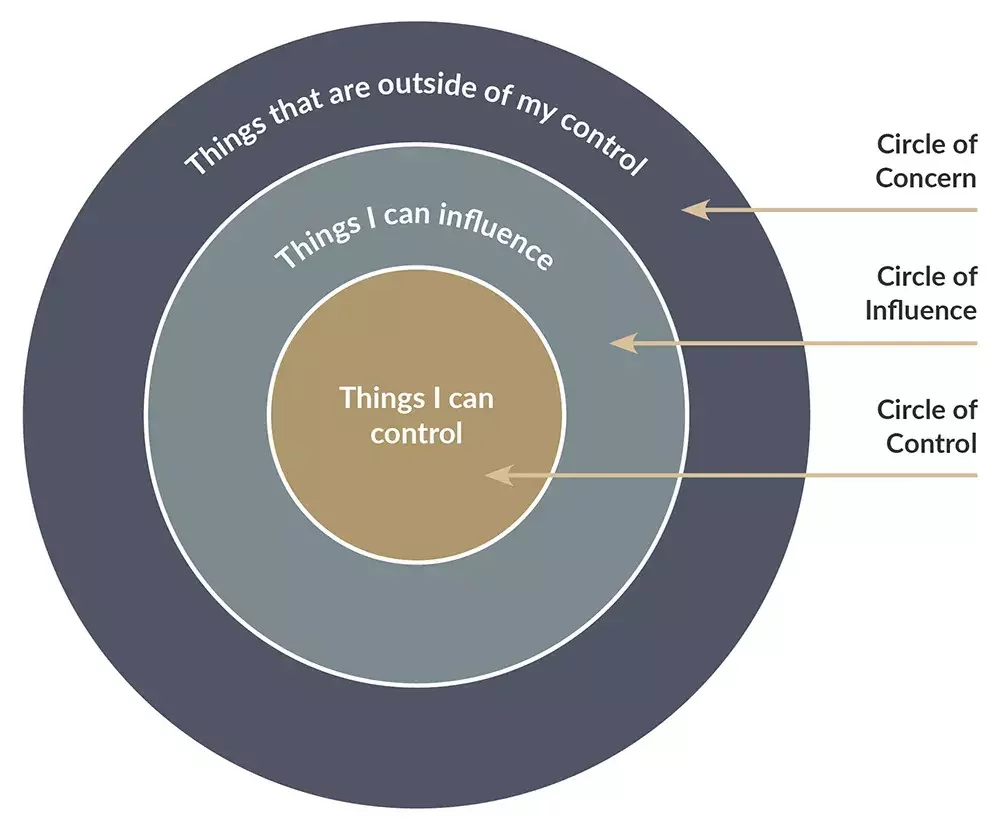
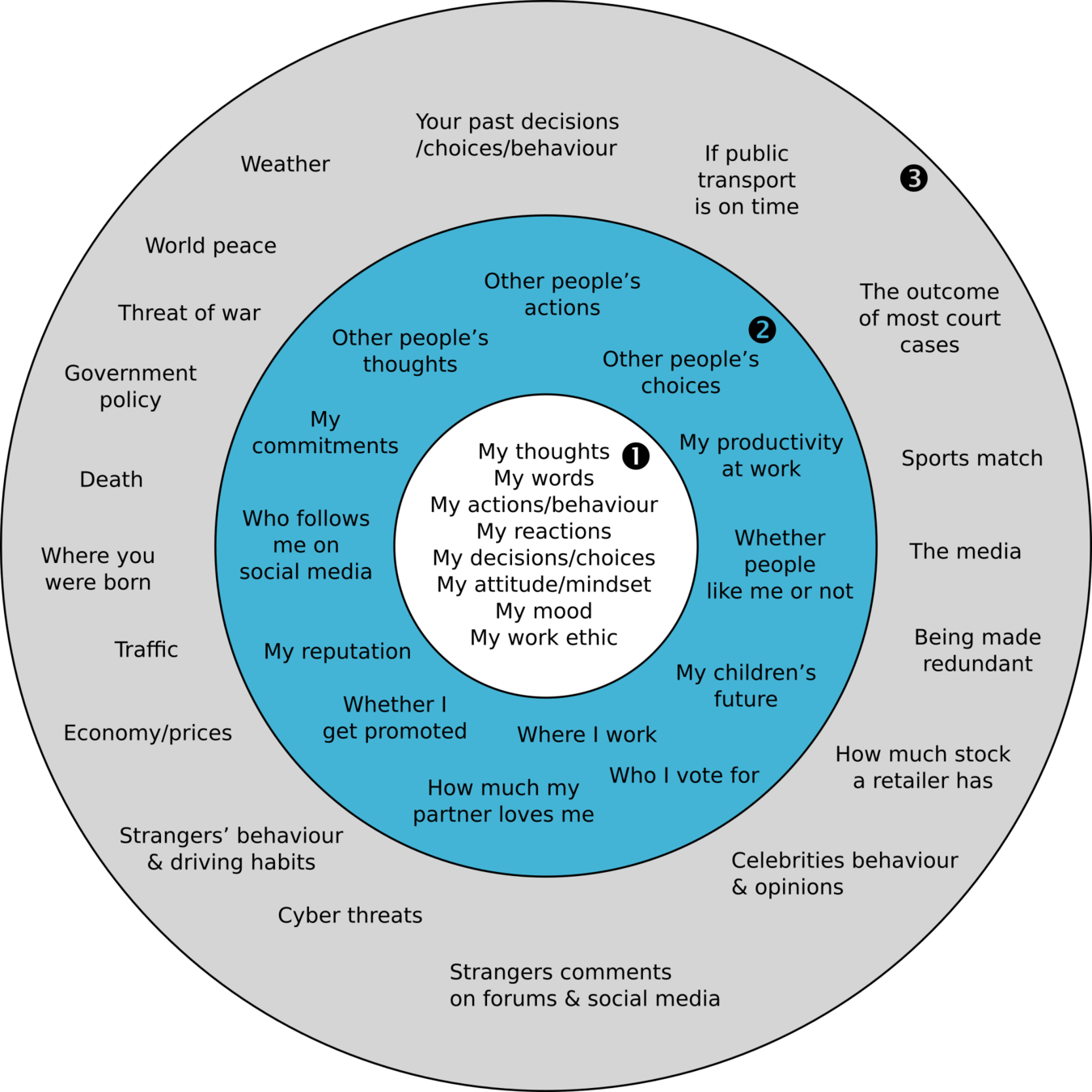
1. circle of control - we can take meaningful action to make a difference to outcomes
2. circle of influence - things we can influence through our efforts but cannot control the outcome
3. circle of concern - external factors we care about but cannot influence
Thinking about what you can control can help your wellbeing too
Focusing our goals on the inner circle of control is most beneficial for both achieving them and our wellbeing, with some of our energy being spent on the circle of influence.
Thinking about what you can control can help your wellbeing too
-
Outside: Which Parliament question appears, what the examiner awards, and where the grade boundary sits.
-
Influence: The feedback I receive on my weakest paragraph. I can help by handing in the essay and asking a focused question.
-
Control: Plan the 25-mark Parliament essay before writing it, and attempt every question on the practice paper.
Thinking about what you can control can help your wellbeing too
LONG ROAD • COMBINED WORKSHOP RESPONSES
Goals: control and specificity
22 responses • Mean ratings on the 1–5 scales
1
1
2
2
3
3
4
4
5
5
Control
Specificity
1
1
Get a good grade in Politics
Control 4.2 · Specificity 2.2 · n=22
2
2
Score higher on my next Paper 1 essay about Parliament than last time
Control 4.5 · Specificity 4.1 · n=22
3
3
Attempt every question in my Politics exams
Control 4.7 · Specificity 3.6 · n=22
4
4
Next Parliament/PM practice: attempt every question and finish a full 25-mark essay within the time limit
Control 4.5 · Specificity 4.6 · n=22
2 Politics sessions combined. These are participants’ judgements, rather than a test score.
This may seem counter intuitive, however the research suggests that telling other people our goals, make us less likely to achieve them!
Here's Huberman again to explain...
Once you have decided on your goal...
...don't tell anyone!!!
OUTCOME CONTROL · TAKE AWAY
Control the next action
Make it specific: what will you actually do?
Choose something you can influence directly.
Turn the goal into one task you can start.
FROM A GOAL TO A NEXT STEP
Force Field Analysis
What helps you move forward?
What gets in the way?
Fitness: what is driving it?
Goal: go to the gym twice a week for six weeks.
DRIVING FORCES →
← RESTRAINING FORCES
More energy
5
Homework and time
4
Feeling better about myself
4
Tired after college
4
Training with a friend
4
Phone or gaming habits
3
Ratings: 1 = weak influence · 5 = strong influence
Which force could you change first?
FORCE FIELD ANALYSIS

LONG ROAD • COMBINED WORKSHOP RESPONSES
Driving and restraining forces
Average strength of each force, from 1 (weak) to 5 (strong)
Driving forces
24 responses • n = ratings of each force
Interest in current affairs
4.14/5
n=22
Understanding how decisions are made
3.29/5
n=21
A future career in politics or law
3.15/5
n=20
Developing my debating skills
3.78/5
n=18
Making a difference to society
3.42/5
n=19
Total strength: 17.77 / 25
Restraining forces
25 responses • n = ratings of each force
Worry about the amount of essay writing
3.52/5
n=23
Keeping up with the news
2.38/5
n=21
Uncertainty about future career options
3.38/5
n=21
Lack of confidence in debates
3.09/5
n=22
Other subjects competing for my time
4.17/5
n=24
Total strength: 16.54 / 25
2 Politics sessions combined. Means use submitted ratings. Totals sum five means; unselected forces are omitted.
FORCE FIELD · TAKE AWAY
Make the next step easier
Strengthen one thing that helps.
Reduce one barrier you can change.
Choose a small action for this week.
DISTRACTION → 25-MINUTE SPRINTS
Protect your attention
Make a short study session count.
LONG ROAD • COMBINED WORKSHOP RESPONSES
Phone distraction while studying
25 responses • 2 of 2 sessions contributed
0%
50%
100%
8%
A
2 answers
44%
B
11 answers
36%
C
9 answers
12%
D
3 answers
A
Never — My phone does not distract me when I study.
B
Sometimes — I can ignore it when I really need to.
C
Most of the time — I can study without it, but it takes a conscious effort.
D
Always — I find it very hard to study without my phone next to me.
2 Politics sessions combined. Percentages use responses to this question.

Cal Newport - Digital Minimalism
Cal Newport, author of Digital Minimalism and Deep Work, explains the psychology of attention, and the impact of our constant need for distraction.
How to beat distraction: Nir Eyal
Big idea: distraction isn’t “laziness” — it’s an urge
-
When work feels uncomfortable, your brain looks for relief.
-
So you need a plan for the moment the urge hits.
Two tools:
-
Plan your time (decide in advance)
-
Surf the urge (notice it, don’t obey it)
You don’t need “more motivation” — you need fewer decisions.
Theme: design your environment + plan the response to urges.

4. 25-Minute Sprints
A focus technique for humans with phones.
THE BASIC SPRINT
25 mins = one task, full focus
5 mins = break / reset
Repeat 2–3 times
Rule: you’re allowed to stop… after 25 minutes.
NON-NEGOTIABLES
-
Phone out of reach (ideally out the room)
-
Everything ready before you start
-
No multi-tasking — one thing only
-
Use a real timer (not your phone)
Start small. Consistency beats heroic sessions.
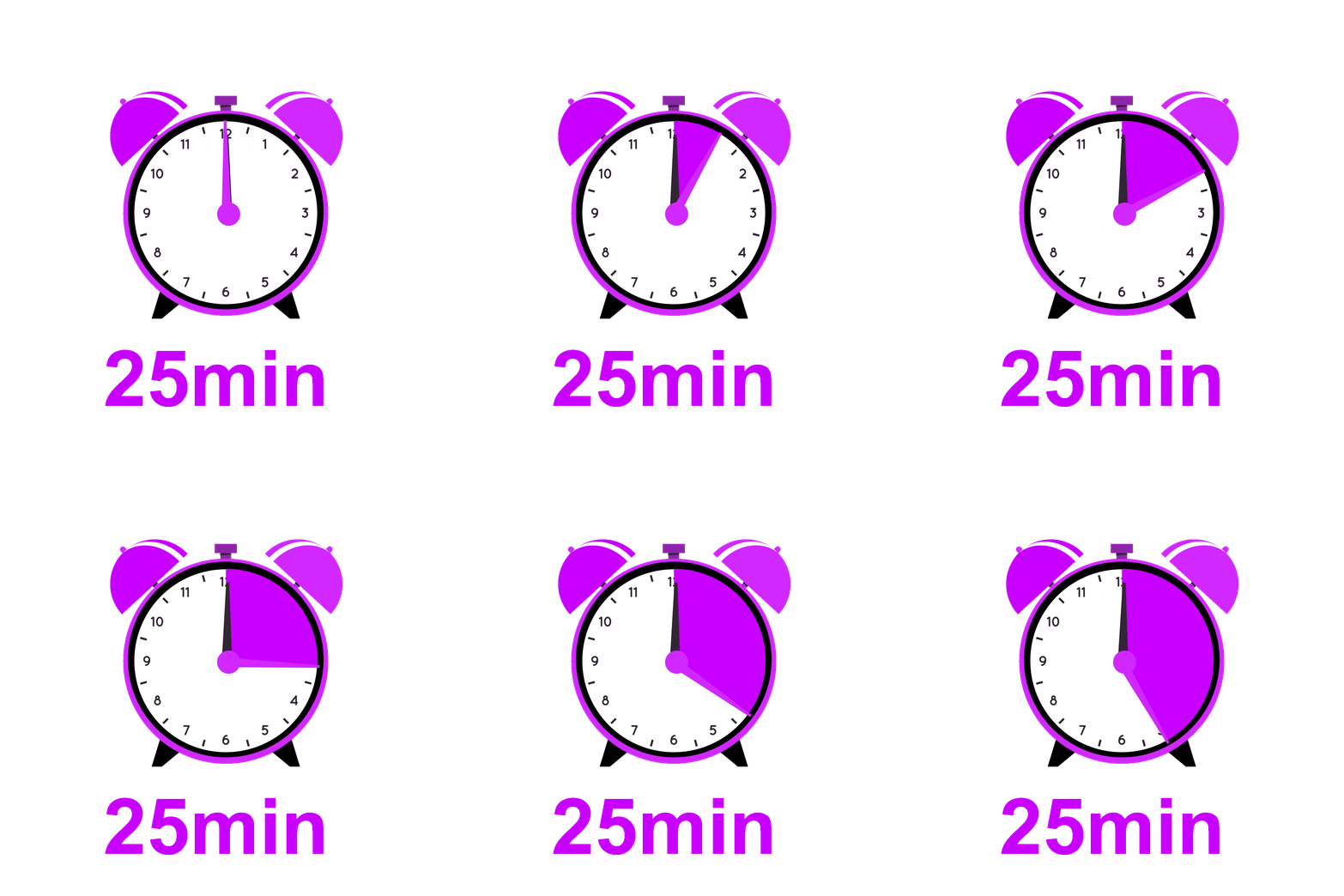
Idea: focus improves when work is time-boxed + distractions are physically removed.
Sprint Training Methods
-
The Quick Sprint
25 on / 25 off / 25 on
-
The Serious Sprint
25 on / 5 off / 25 on / 5 off / 25 on
-
Measure tasks in sprints
Before you start: “How many sprints will this take?”
-
The Review Sprint
Use a sprint to mark, fix, and summarise what you did last sprint.
Aim: leave each sprint with something finished.
FOCUS · TAKE AWAY
One sprint. One clear output.
Choose the task before you start.
Put distractions out of reach.
Work for 25 minutes, then take a short break.
CORNELL NOTES
Make your notes work
Move from collecting information to using it.
LONG ROAD • COMBINED WORKSHOP RESPONSES
How students use their notes
26 responses • 2 of 2 sessions contributed
0%
50%
100%
0%
A
0 answers
31%
B
8 answers
62%
C
16 answers
8%
D
2 answers
A
I listen carefully, but make no notes.
B
I take notes, but do not reread them.
C
I take notes and reread them.
D
I take notes, reread them, then check and improve them using a handout or textbook.
2 Politics sessions combined. Percentages use responses to this question.
Kenneth Kiewra
Professor,
University of Nebraska

....conducted several studies, to investigate the effectiveness of notetaking
The next slide shows his findings.
Can you guess the correct percentage scores for each group of students?
Students listened to a 1500 word lecture on how memory works. They were then split into two groups to then take a test..
| 1 | ||
| 2 | ||
| 3 | ||
| 4 |
Note taking technique
Test Score
Listened carefully, but made no notes
Took notes, but didn’t re-read them
Took notes and re-read them
Took notes, re-read them, then checked and improved them against a handout/text-book
43%
44%
51%
71%
His findings suggest the key is what you do after you’ve taken the initial notes.
CORNELL NOTES
Returning to the notes obviously helps, but it’s not the reading of those notes that necessarily has an impact
..It’s returning to develop the notes through things like…
-
Clarifying material with additional underlining, arrows, subheadings and reminders
-
Adding to the material with questions: ‘how’ or ‘why’ questions that work like a test, encouraging you to explain what you’re reading
-
Adding to the material with clarifications you’ve got from text books/study guides, expanding the material with deeper additional information
CORNELL NOTES · TAKE AWAY
Use the cues to test yourself
Turn your notes into questions.
Cover the answer and recall it.
Check, correct and return later.
CHECK YOUR STARTING POINT
Confidence and evidence
What tells you that you are making progress?
LONG ROAD • COMBINED WORKSHOP RESPONSES
Expected A-level grade
25 responses • 2 of 2 sessions contributed
0%
50%
100%
0%
A*
0 answers
12%
A
3 answers
72%
B
18 answers
16%
C
4 answers
0%
D
0 answers
0%
E
0 answers
0%
U
0 answers
Students’ expected grades at the time of the workshop.
2 Politics sessions combined. Percentages use responses to this question.
LONG ROAD • COMBINED WORKSHOP RESPONSES
What grade predictions are based on
26 responses • 2 of 2 sessions contributed
0%
50%
100%
31%
A
8 answers
35%
B
9 answers
8%
C
2 answers
27%
D
7 answers
A
A recent timed answer, marked against the exam criteria.
B
Practice answers or feedback, but not yet under timed conditions.
C
The material feels familiar when I read or hear it.
D
Mostly a feeling — I have not tested it yet.
2 Politics sessions combined. Percentages use responses to this question.
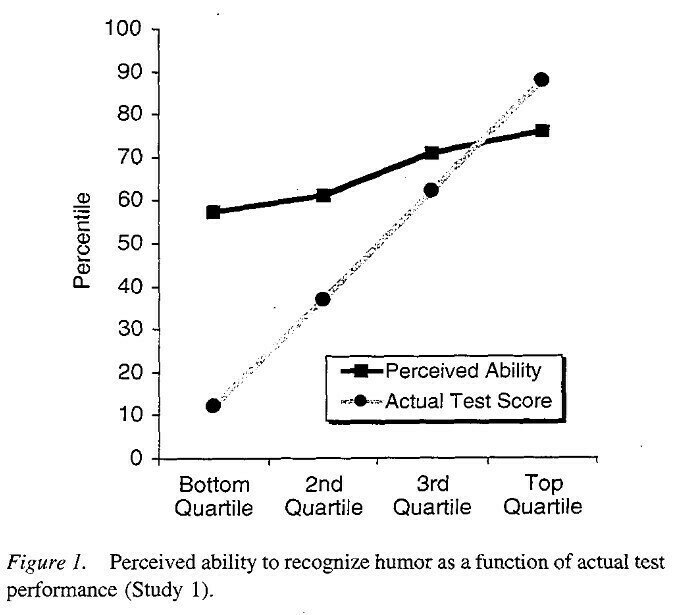
DUNNING–KRUGER IN ONE SENTENCE..
We are most confident when we are least informed.
And revision is full of things that make us feel confident… without improving performance.
Strategic Study
Why it works: it forces retrieval + explanation (high utility). It reveals gaps fast (Dunlosky et al., 2013).
High Will
High Skill
Low Will
Low Skill

Democracy
Elections
Parties
Parliament
Government
The constitution
Rights
Political ideas
Participation
Beware of the Magnet!!
LONG ROAD • COMBINED WORKSHOP RESPONSES
Will and skill across the course
20 responses • Mean ratings on the 1–5 scales
Topic
Skill / 5
Will / 5
Ratings
Constitutions
3.9
3.4
20
Legislatures
3.7
3.4
19
Executives
3.7
3.5
19
Judiciaries
2.5
2.9
17
Rights and civil liberties
2.9
2.9
18
Democracy, elections and voting
3.7
3.2
19
Political parties
3.2
3.1
15
Pressure groups
2.2
2.0
15
Core ideologies
4.1
3.7
19
Optional ideology
3.4
3.6
19
2 Politics sessions combined. Skill = confidence; Will = motivation. Only rated topics enter each mean.
THOUGHTS

-
It’s important to choose a high energy, positive time of the day to tackle your Low will / Low skill topics and subjects
-
If you had to choose a time of day when you feel most alert, which of the following would it be?
-
Early morning
-
Late morning (pre-lunch)
-
Early afternoon (post lunch)
-
Late afternoon (just after school)
-
Evening
-
-
Now choose a day of the week when you’ve got some space and freedom at that time of day.
-
Set aside an hour or two to tackle a Low will / Low skill topic or subject
-
Finally, make sure you line up a great reward for getting the job done!
REVISION THAT
ACTUALLY WORKS
And why it feels harder than it should
Three big ideas:
-
Your brain misjudges learning
-
Comfort is not progress
-
Systems beat willpower
Today we’ll give you:
-
The research behind what works
-
The methods that outperform re-reading
-
A simple plan for the next 7 days
WHY ARE YOU DOING THIS?
Before we talk about methods, let’s remember the point of all this.
Short-term
discomfort
→
Long-term
options
Quick reflection:
What do you want your future self to thank you for?
Where do you want these grades to take you?
Long-term
regret!
Short-term
comfort
→
LONG ROAD • COMBINED WORKSHOP RESPONSES
How students usually study
14 responses • 1 = Never; 5 = Most study sessions
Reread notes or a textbook
3.2/5
Highlight or underline key information
2.7/5
Copy or rewrite notes
2.9/5
Watch explanation videos
3.1/5
Recall information with the notes closed
4.1/5
Answer practice or exam questions
3.4/5
Explain a topic aloud to someone
3.4/5
Return to a topic on different days
3.4/5
2 Politics sessions combined. Each mean pools individual ratings. The methods keep their questionnaire order.
WHY GOOD REVISION FEELS HARD
Robert Bjork — UCLA psychologist
“Desirable difficulties”
Difficult learning conditions often improve long-term memory.
Research snapshot: Bjork (UCLA, 1990s–). Studies show that introducing difficulty during learning can improve long-term retention and transfer, even if performance feels worse during practice.
WHY GOOD REVISION FEELS HARD
Robert Bjork: “desirable difficulties” build stronger memory.
Feels good now
-
Re-reading
-
Highlighting
-
Copying notes
Works later
-
Retrieval (closed-book)
-
Teaching out loud
-
Spacing over days/weeks
Rule of thumb: If it feels a bit uncomfortable, it’s probably doing something useful.
Research snapshot: Robert Bjork (UCLA, 1990s–) — certain difficulties during learning can improve long-term retention and transfer, even if performance feels worse in the moment.
LEARNING IS WEIRD BECAUSE…
What feels easy often feels like learning.
But what works often feels hard.
So for revision we need evidence… not vibes.
WHAT THE RESEARCH SAYS WORKS
John Dunlosky — Kent State University

In 2013, he reviewed study strategies and rated them by impact on performance.
Research snapshot: Dunlosky et al. (2013) reviewed evidence for common study techniques and grouped them by “utility” (how reliably they improve learning).
HIGH UTILITY vs LOW UTILITY
Some methods feel productive… but don’t move the needle much.
LOW UTILITY
(feels good now)
Re-reading notes
Highlighting as you read
Copying / pretty notes
HIGH UTILITY
(works later)
Practice testing (retrieval)
Spacing practice over time
Teaching / explaining out loud
Key idea: your brain confuses familiar with learned.
Research snapshot: Dunlosky et al. (2013) — practice testing and distributed (spaced) practice show strong, consistent benefits across many contexts.
HIGH VS LOW UTILITY · CONCLUSION
Make revision do some work
Use notes to get started. Turn them into questions.
Close the notes and try an answer.
Check the gaps. Return on another day.
Judge the session by what you can do afterwards.
LONG ROAD • COMBINED WORKSHOP RESPONSES
How students choose what to study
13 responses • 1 of 2 sessions contributed
0%
50%
100%
0%
A
0 answers
54%
B
7 answers
46%
C
6 answers
0%
D
0 answers
A
I decide in the moment when I sit down to study.
B
I have a rough idea or a basic plan in my head.
C
I have a plan of which subjects to study.
D
I plan specific topics and prioritise gaps shown by practice or feedback.
2 Politics sessions combined. Percentages use responses to this question.
LONG ROAD • COMBINED WORKSHOP RESPONSES
The group’s study habits
14 responses • Mean scores out of 10
6.0/10
Content
Revisiting and organising knowledge
5.6/10
Skills
Practising exam skills and spacing study
4.5/10
Feedback
Using feedback to improve answers
2 Politics sessions combined. Always = 10, Sometimes = 5, Never = 0. Three habits per section.
YOUR QUESTIONNAIRE · WHAT IT MEANS
Read your study profile
CONTENT
Revisit and organise what you need to know.
SKILLS
Practise what the exam asks you to do.
FEEDBACK
Check your work and improve the next attempt.
These are reported habits, not a grade or a judgement of your ability.
YOUR QUESTIONNAIRE · NEXT STEP
Choose one habit to strengthen
Content: make a short set of cue questions.
Skills: attempt a question without your notes.
Feedback: check it, find one gap and try again.
Choose the area you use least. Add one action to your next session.
EXPLAIN · QUESTION · CHECK · RETRY
AI as a study partner
How are you using it now?
How could it help you do the thinking?
LONG ROAD • COMBINED WORKSHOP RESPONSES
How students use AI for study
24 responses • 2 of 2 sessions contributed
0%
50%
100%
21%
A
5 answers
4%
B
1 answer
54%
C
13 answers
21%
D
5 answers
A
I use AI as a tutor to test me and find weaknesses.
B
I use AI to write essays or complete work for me.
C
I use AI to explain topics or create study resources.
D
I don’t currently use AI for study.
2 Politics sessions combined. Percentages use responses to this question.
USING AI TO REVISE

Transaction
Interaction
Cultivation
Learning is a chore. If something can do the work for me, I complete the transaction quicker and with less effort.
I need more feedback. I’m looking for something to tell me where I’m going wrong, or advise me on how I can improve.
I plan on getting significantly better at this subject. I want something that can test me, assess me and push me.
-
Can I get AI to write me the perfect answer?
-
Can I outsource all the hard thinking, find a shortcut and get an outcome quickly?
-
Can ChatGPT design my timetable for me?
-
Can I talk a problem through?
-
Can I get a steer on where I’m missing marks?
-
Can I outsource the assessment and feedback?
-
Can I improve my understanding by generating tests and exams?
-
Can I challenge myself more in this subject?
-
Can I outsource lesson planning?
AI AS A STUDY PARTNER
Give it the context.
I study AQA A-level Politics (7152). Help me revise Paper 1: Parliament and scrutiny of the executive. Use the course material I provide; flag anything uncertain.
AQA 7152 · Parliament · trusted course materials
INTERACT
Make yourself answer first.
Ask me one question at a time about how Parliament scrutinises the executive. Wait for my answer. Ask “why?” or “how?” before giving feedback.
CHECK
Feedback needs a reference.
Check my knowledge (AO1), analysis (AO2) and evaluation (AO3) against the AQA material I supply. Identify one strength and one gap. Do not invent a mark scheme, citation or grade.
Check the feedback against your notes and specification.
CULTIVATE
Try again without the answer.
Ask a new question on the same idea. Do not show the answer. After I respond, help me check whether I have fixed the gap.
The useful output is your understanding.
AI REVISION · TAKE AWAY
Keep yourself in the learning loop
Give it the context and trusted course material.
Answer first. Ask for feedback you can check.
Try again without the answer in front of you.
STRATEGIC STUDY · STUDY COMMITMENT
Turn your priorities into a plan
Choose a Politics topic that needs attention.
Protect a study time you can realistically use.
Give the session one clear task.
A short walkthrough of how to make a useful study plan.
STUDY COMMITMENT
A plan for next week
1 Open a blank plan
2 Choose study times you can protect
3 Reserve a weekly planning session
Choose realistic slots across the week.
STUDY COMMITMENT
Every session needs a clear task
4 Choose the subject and topic
5 Choose a study method and a clear output
6 Save the plan and add it to your calendar
Work through each session, one at a time.
STUDY COMMITMENT
The study planner
A topic you need to practise
A task you can complete
A time you can protect
Return to the plan and adjust it as you learn.
STRATEGIC STUDY · TAKE AWAY
Make the plan happen
A topic you need. A task you can finish.
A time you can protect.
Return to your plan and adjust it as you learn.
SO… WHAT SHOULD YOU DO?
Use methods that force your brain to retrieve…
and build systems that help you stick with discomfort.
-
Command verbs (practise the answer asked for)
-
Closed-book note-taking (retrieval)
-
Teach an imaginary class (explain it)
-
Spaced repetition (return to practice over time)
Next: I’ll show you exactly how to do each one.
Four ways exams ask you to think
From knowing the facts to making a supported judgement.
1. Define & describe
Recall facts, key details and processes.
Recall key dates and people. Describe a political process.
2. Explain & apply
Explain a process. Apply what you know.
Explain how a process works. Apply it to a problem.
3. Analyse & compare
Break ideas apart. Explore connections.
Compare political systems. Explain similarities and differences.
4. Judge & justify
Support your judgement with evidence.
Justify your view. Make an evidence-based prediction or recommendation.
A thinking guide. Read the whole question, its context and the marks available.
The command-verb reference
Different words signal different kinds of thinking.
1. Define
& describe
& describe
Label
Annotate
List
Define
Describe
Select
State / Relate
Outline
Summarise
Illustrate with examples
2. Explain
& apply
& apply
Explain
Comment on
Determine
Demonstrate
Identify / Infer
Calculate
Show / Prove / Set out
Verify / Give reasons for / Consider
Translate
Correct
3. Analyse
& compare
& compare
Analyse
Examine
Explore
Compare and contrast
Differentiate between
Distinguish between
Survey
Review
Investigate
Solve
4. Judge
& justify
& justify
Discuss / “To what extent…”
Evaluate
Assess
Argue
Justify
Criticise
Suggest / Propose
Make a case for
Predict
Recommend
Examples across subjects. Check your exam board’s definitions and the whole question.
AQA POLITICS · PRACTICE THE ANSWER
Same topic.
Different task.
Parliament: what must your answer actually do?
| Command | Example task | Your answer needs to… |
|---|---|---|
| Explain and analyse | Three ways Parliament scrutinises government. | Develop three supported points. |
| Analyse and evaluate | A view about Parliament’s effectiveness. | Weigh arguments and reach a judgement. |
| Analyse, evaluate and compare | Arguments in extracts about Parliament. | Engage with the arguments and compare them. |
Practise the kind of answer the question asks for.
TRY IT WITH YOUR CHOSEN TOPIC
Command Verbs: your next step
Choose an exam question. Underline the command word. Practise the answer it asks for.
Add a specific task and time to your study plan.
2. Closed-Book Note-Taking
Retrieval > Re-reading
-
Read a short section (2–3 pages max).
-
Close the book.
-
Write everything you can remember.
-
Reopen and add what you missed in another colour.
-
Repeat later in the week (spacing).
If it feels hard… it’s probably working.
Research: Retrieval practice strengthens long-term memory more than re-reading (Dunlosky et al., 2013; Roediger & Karpicke, 2006).
TRY IT WITH YOUR CHOSEN TOPIC
Closed-Book Notes: your next step
Close the book. Recall what you know. Check and add the gaps in another colour.
Add a specific task and time to your study plan.
3. The Feynman Teach-Back
If you can teach it simply… you can write it in the exam.
-
Pick a small chunk (one concept / one page).
-
Close the book.
-
Teach it out loud for 2 minutes (like a Year 7).
-
When you waffle or get stuck, mark a ★.
-
Reopen and fix the ★ gaps (that’s your real revision list).
Use these starter lines:
“Today I’m explaining…”
“The big idea is…”
“A simple example is…”
“In an exam they might ask…, so you must be able to…”
Why it works: it forces retrieval + explanation (high utility). It reveals gaps fast (Dunlosky et al., 2013).
TRY IT WITH YOUR CHOSEN TOPIC
Feynman Teach-Back: your next step
Explain it simply, without notes. Find the gap. Check it and explain again.
Add a specific task and time to your study plan.
4. Spaced Repetition
Don’t cram the same day. Repeat over time.
THE PROBLEM
We forget quickly after learning.
Re-reading feels good… then vanishes.
In exams, “I saw it” ≠ “I can recall it”.
THE SOLUTION
Test yourself… then leave a gap.
Come back just as you’re starting to forget.
Each successful recall strengthens memory.
Rule: If you always get it right, you’re reviewing too soon.
Research: Forgetting curve (Ebbinghaus, 1880s). Spaced practice improves long-term retention (Cepeda et al., 2006).
TRY IT WITH YOUR CHOSEN TOPIC
Spaced Repetition: your next step
Choose what to recall. Put two return dates in your plan. Test yourself before checking.
Add a specific task and time to your study plan.
Three reasons to change your study
Active revision. Sustained effort. Notes you use.
Active revision
11.1–16.6%
Higher exam scores associated with using six active strategies rather than none.
University Biology; two exams. Walck-Shannon et al. (2021).
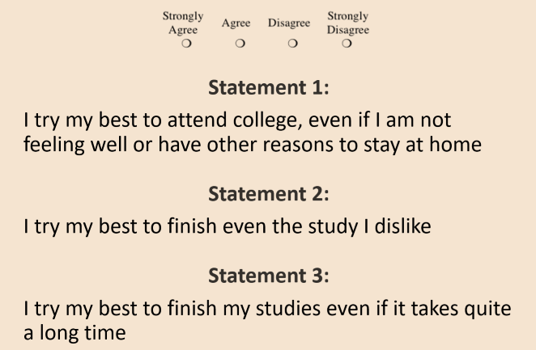
“Try your best”
12.7%
Students that Agreed or Strongly Agreed to statements about trying their best. Scored on average 12.7% higher in Tests.
Chinese junior-high pupils. Jin (2024).
Cornell Notes
8%
Handwritten Cornell versus personal notes.
All note-taking groups beat no notes. Evans & Shively (2019).
37.3%
Total Potential Gain:
TAKE IT INTO NEXT WEEK
Your current grade
is not your ceiling.
AQA Politics 7152 · June 2025 · whole qualification
C → B: 26 marksB → A: 27 marks
Historical example, not a prediction. Boundaries change with the exam series.
19.0%
E
44/231
30.3%
D
70/231
41.6%
C
96/231
52.8%
B
122/231
64.5%
A
149/231
75.8%
A*
175/231

What if there was an wayto get digital content based on your EXACT Subject Specifications??
STUDY RESOURCES
Flashcards for your
subject specification
Choose a topic. Test your recall.
Check the gaps and return later.
www.fl4shcards.com




LONG ROAD • COMBINED WORKSHOP RESPONSES
Quiz 1: a goal you can act on
14 responses • 1 of 2 sessions contributed
Which is the most specific goal that is mainly within your control?
0%
50%
100%
14%
A
2 answers
7%
B
1 answer
71%
C ✓
10 answers
7%
D
1 answer
A
Get the highest Politics mark in the college
B
Become Prime Minister
C
Complete every question, including the 25-mark essay, in my next timed Parliament practice
D
Be better at Politics
2 Politics sessions combined. Correct answer: C. Percentages use responses to this question.
LONG ROAD • COMBINED WORKSHOP RESPONSES
Quiz 2: a useful study sprint
14 responses • 1 of 2 sessions contributed
What makes a 25-minute study sprint useful?
0%
50%
100%
100%
A ✓
14 answers
0%
B
0 answers
0%
C
0 answers
0%
D
0 answers
A
A clear task, distractions out of reach, then a short break
B
Switch tasks whenever a notification arrives
C
Spend the time choosing the perfect playlist
D
Keep going for hours without a break
2 Politics sessions combined. Correct answer: A. Percentages use responses to this question.
LONG ROAD • COMBINED WORKSHOP RESPONSES
Quiz 3: using Cornell Notes
13 responses • 1 of 2 sessions contributed
What should you do with the cue questions in Cornell Notes?
0%
50%
100%
0%
A
0 answers
54%
B
7 answers
0%
C
0 answers
46%
D ✓
6 answers
A
Use them only as decoration
B
Read the answer while asking the question
C
Copy the whole page again
D
Cover the notes, answer from memory, then check
2 Politics sessions combined. Correct answer: D. Percentages use responses to this question.
LONG ROAD • COMBINED WORKSHOP RESPONSES
Quiz 4: force field analysis
11 responses • 1 of 2 sessions contributed
How can Force Field Analysis help you make progress?
0%
50%
100%
9%
A
1 answer
64%
B ✓
7 answers
27%
C
3 answers
0%
D
0 answers
A
Set more goals until you feel busy
B
Strengthen what helps and reduce what gets in the way
C
Wait until every barrier has disappeared
D
Compare your motivation with everyone else
2 Politics sessions combined. Correct answer: B. Percentages use responses to this question.
LONG ROAD • COMBINED WORKSHOP RESPONSES
Quiz 5: making learning last
13 responses • 1 of 2 sessions contributed
Which plan best combines retrieval and spacing?
0%
50%
100%
0%
A
0 answers
8%
B
1 answer
92%
C ✓
12 answers
0%
D
0 answers
A
Reread all your notes once the night before
B
Highlight the same page every day without testing
C
Recall without notes, check mistakes, then revisit across different days
D
Wait until everything feels easy before testing yourself
2 Politics sessions combined. Correct answer: C. Percentages use responses to this question.
TAKE IT WITH YOU
Your next step
starts next week.
One change.
One specific task.
One time in your plan.
Thank you — and good luck.
Long Road Politics — workshop slides and combined responses
By Tony Dennis
Long Road Politics — workshop slides and combined responses
October 2026 AQA Politics workshop for Long Road Sixth Form College. Teaching slides with anonymous combined results from all 2 school sessions.